Knowledge
What is an exoskeleton?
When people hear the term “exoskeleton,” they often first think of futuristic robotic suits from Hollywood blockbusters that grant superpowers. In reality, however, most models are not designed to give their wearers superhuman strength, but rather to assist them with physically demanding tasks. In this form, exoskeletons have long since become part of the real working world. Among other places, they are used in the manufacturing, logistics, manufacturing and in trades and in the healthcare sector, they are already being used successfully.
But what exactly is an exoskeleton? How does it work? And why is this technology becoming increasingly important in many companies?
definition
What is an exoskeleton?
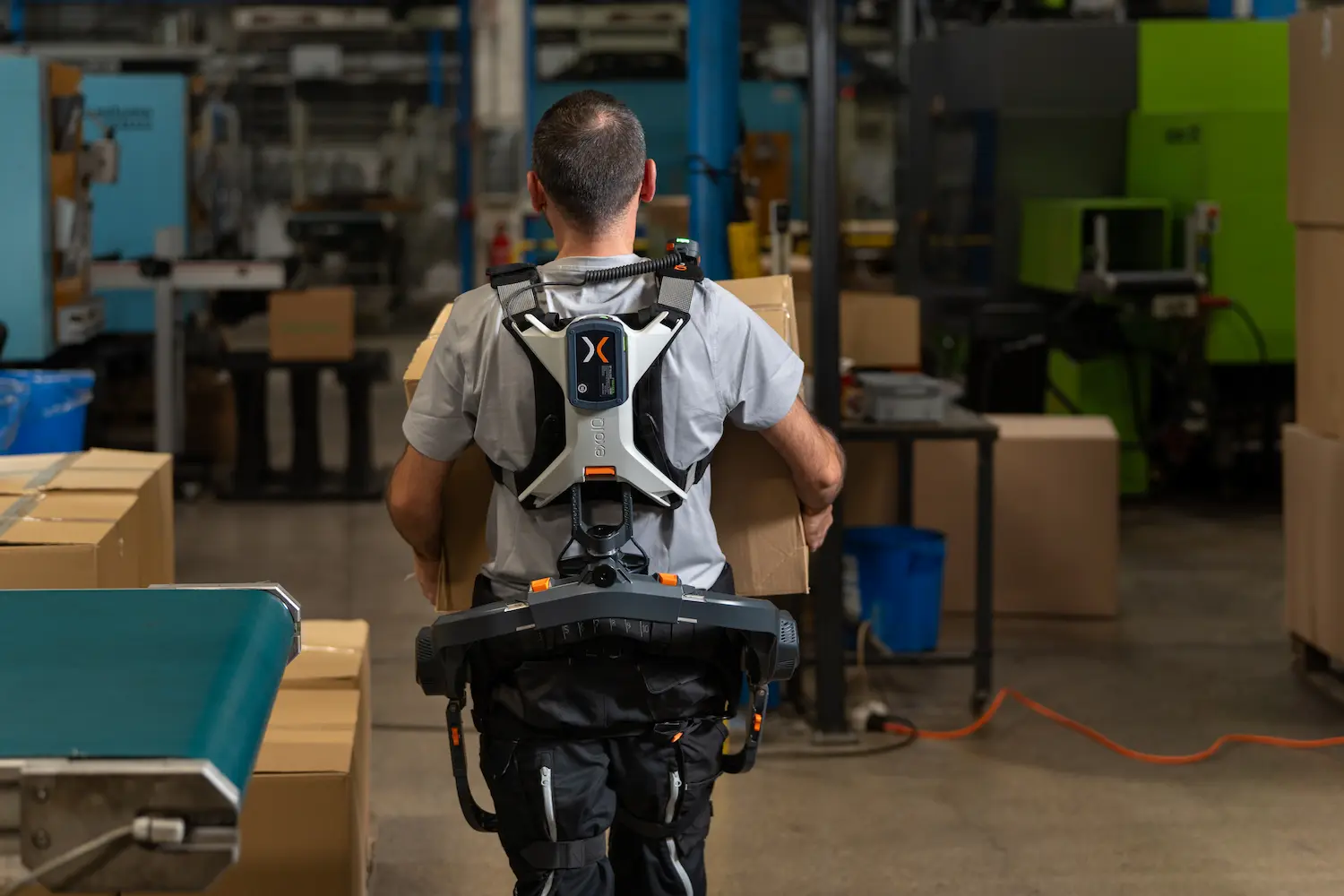
An exoskeleton is a support structure worn on the body that can reduce the physical strain on people during heavy work. Depending on the model and application, it is put on much like a backpack and supports, for example, the shoulders during overhead work or the back when lifting and carrying.
Unlike machines or robots, exoskeletons do not take over a person's work. Instead, they help reduce physical strain and make work more ergonomic.
In a nutshell
An exoskeleton is a wearable support system that provides additional force and helps absorb and distribute loads acting on the body, thereby reducing the strain on muscles and joints during physically demanding activities.
meaning
Where does the term "exoskeleton " come from?
The term "exoskeleton" comes from Ancient Greek and is composed of two words:
- exo = outside
- skeletos = framework or skeleton
Literally, "exoskeleton" means "outer skeleton."
The term originally comes from biology. In that field, an exoskeleton refers to the rigid outer shell of certain animals, such as beetles, spiders, or crabs.
While humans and other vertebrates have an internal skeleton, the supporting structure in these organisms is located on the outside. It protects the body and provides stability.
Modern technical exoskeletons are not directly modeled after their natural counterparts. The basic idea, however, is similar: an external structure supports the body during certain tasks.
History
The History of Exoskeletons
The idea of using technology to ease the burden on people when performing heavy work is not new. Researchers and engineers have been exploring this topic for many decades.
The first exoskeleton concepts had one primary goal: to make physically demanding tasks easier or to enhance a person’s physical capabilities. In practice, however, many of these early systems were still too heavy, too bulky, or not technically mature enough for everyday use.
It wasn't until the technological advances of recent years that this changed. Lighter materials, more powerful batteries, and modern sensors have made exoskeletons significantly more compact and comfortable.
Today, exoskeletons are no longer a technology of the future. Many companies are already using them as tools to make physically demanding jobs more ergonomic. This is especially true in areas such as manufacturing or logistics , they are used in situations where employees regularly lift, carry, or work in awkward positions for extended periods of time.
How It Works
How does an exoskeleton work?
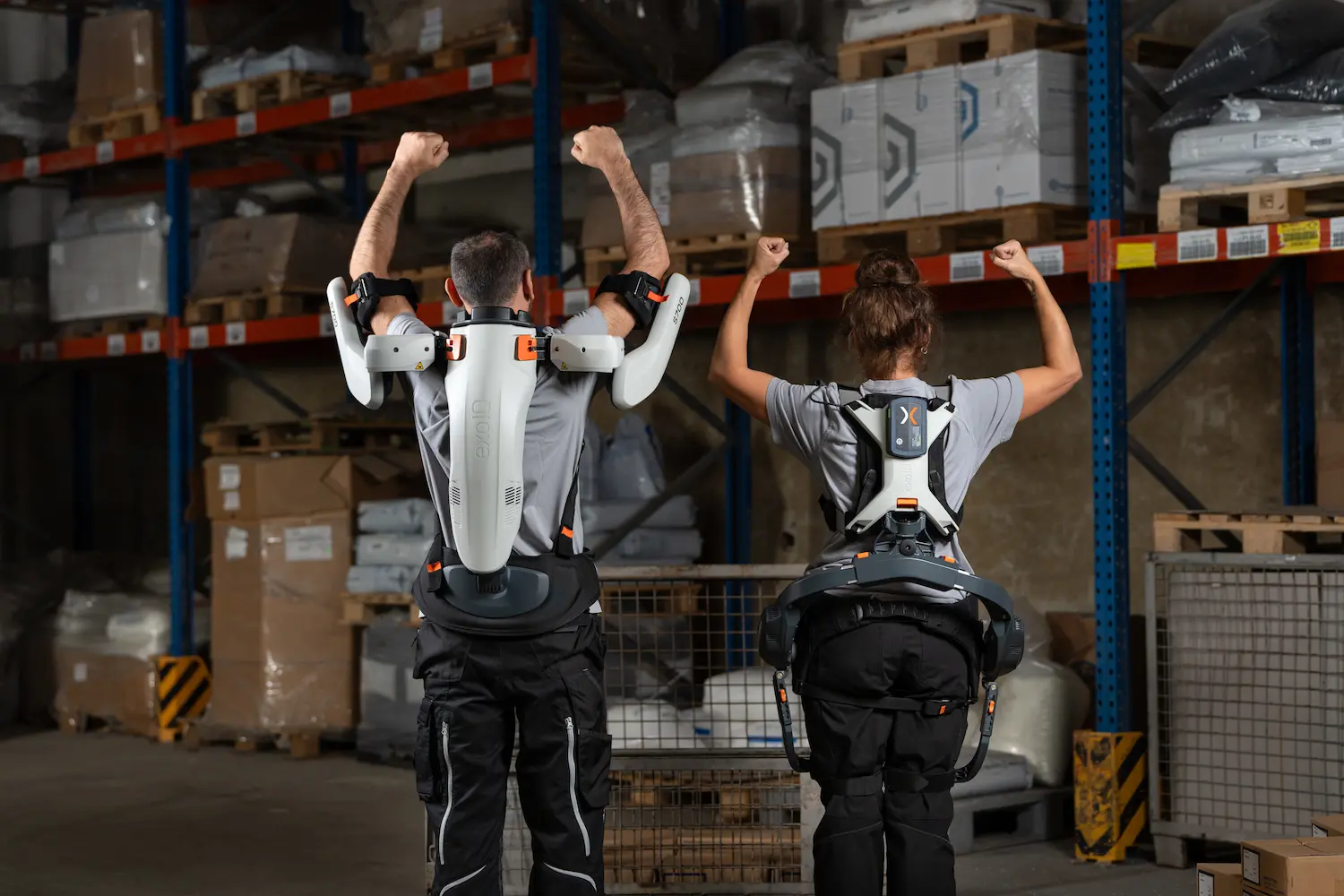
Most exoskeletons operate on a simple principle: they support the human body during physically demanding activities by providing additional force. Depending on their design, they can even partially take over the loads acting on the body and redistribute them in a targeted manner. This relieves strain on muscles and joints and makes physically demanding activities easier to perform ergonomically.
Relief for the Muscles
In many types of work, certain muscle groups must withstand high levels of strain over extended periods of time. This applies, for example, to:
- Working overhead
- repeated lifting and carrying
- Activities Performed in a Forward-Leaning Position
- holding tools or components for longer periods of time
An exoskeleton can take over some of the necessary muscle force. As a result, the muscles involved have to work less. This is particularly noticeable during repetitive or prolonged activities, because the muscles tire much more slowly.
Support for Movements
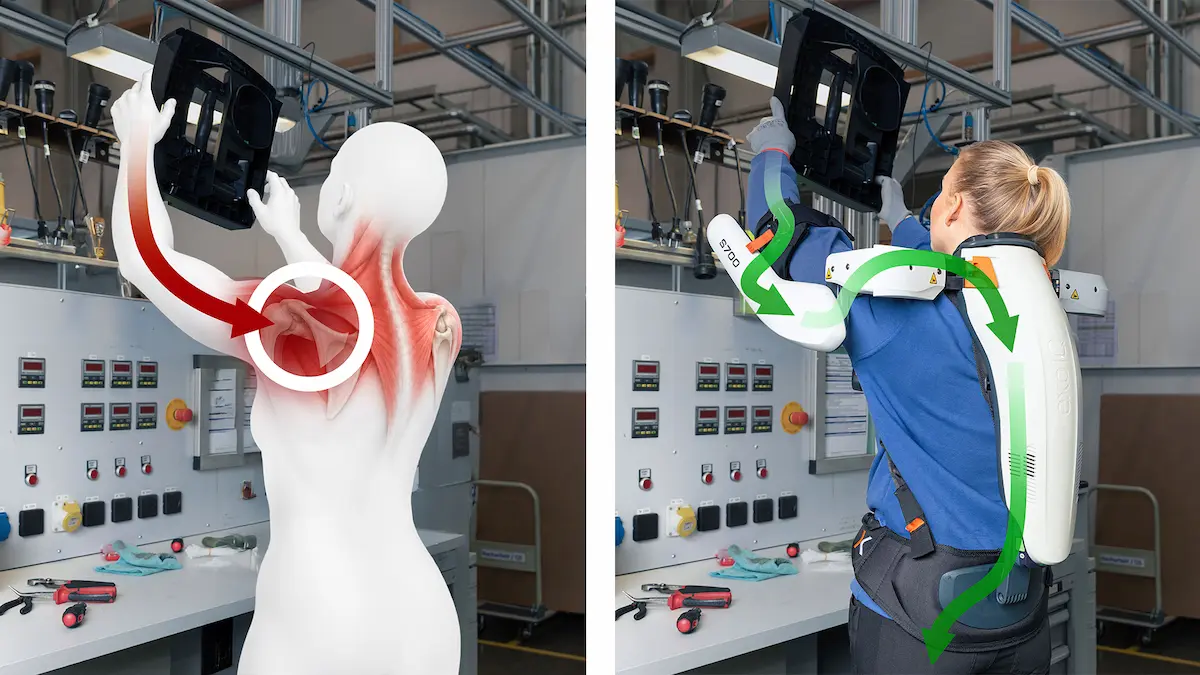
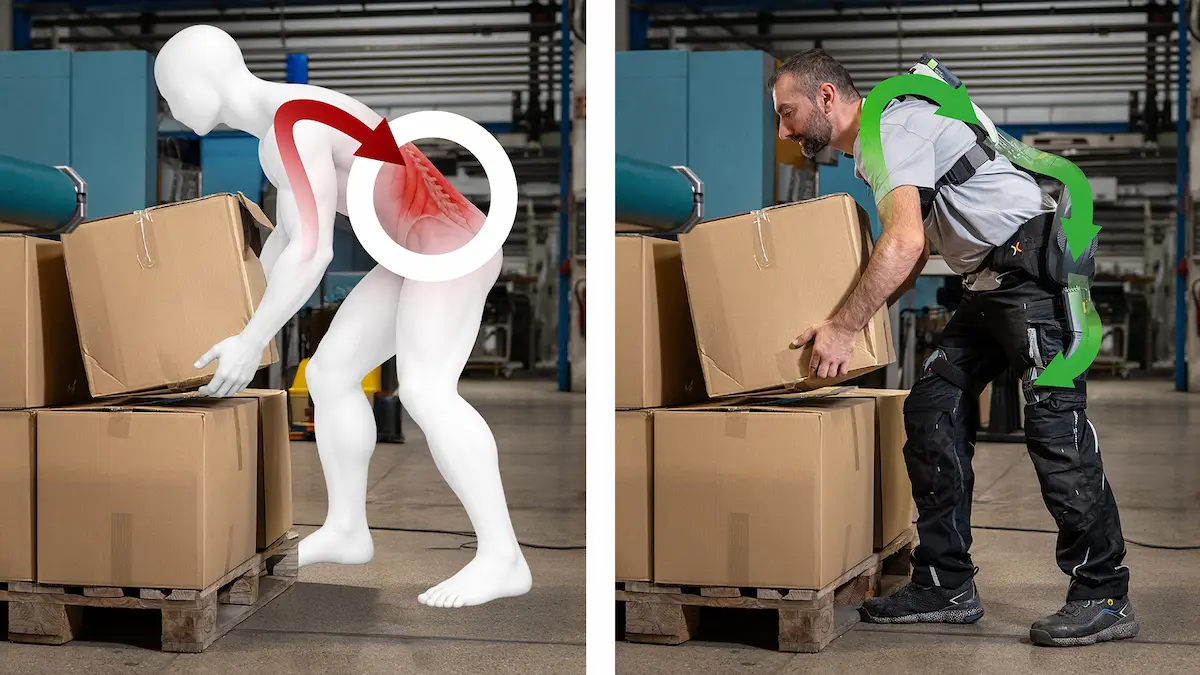
Exoskeletons help provide some of the force required for physically demanding activities. For example, they can assist with raising the arms during overhead work or straightening the upper body after bending forward.
This preserves the body's natural movement while relieving strain on the muscles and joints.
Support Through Power Transmission
Many exoskeletons also support the body by absorbing stress through their structure and transferring it to other parts of the body, such as the hips, pelvis, or legs . This relieves strain on individual muscles and joints, making it easier to perform physically demanding activities.
In a nutshell
Exoskeletons do not grant “superpowers.” Their benefit lies in reducing physical strain by providing force assistance for specific movements, partially absorbing loads, and redistributing them in a way that is less taxing on the body.
Overview
What types of exoskeletons are there?
Generally, a distinction is made between passive and active exoskeletons.
Passive exoskeletons operate without an external power source and use mechanical elements such as springs or elastic components to assist movement and reduce strain.
Active exoskeletons are equipped with technical components such as motors, sensors, and control systems that can assist with movement depending on the situation.
Applications
Where are exoskeletons used?
Today, exoskeletons are an integral part of workplace ergonomics in many fields. They complement traditional measures for ergonomic workplace design. Here are a few examples.
Industry and Manufacturing
e.g., overhead work, assembly processes, and tasks performed in awkward postures
e.g., lifting, carrying, and handling processes
Craft
e.g., assembly work, grinding work, or tasks that require working above shoulder height for extended periods
Care
e.g., moving and positioning patients
Advantages
What are the benefits of exoskeletons?
The effects that can be achieved through their use depend on many factors, including the type of activity, the type of exoskeleton, and the operating conditions.
The key benefits include:
Reduce physical strain
Reduce Fatigue
Provide support for ergonomically poor postures
Preventing Musculoskeletal Problems
Maintaining long-term work capacity

Increasing Employee Satisfaction at
It is important to note that exoskeletons are not a substitute for other ergonomic measures, but rather a useful addition to making work more ergonomic.
Exoskeletons at a Glance
- What is an exoskeleton?
An exoskeleton is a wearable assistive device that can reduce the physical strain on people during physically demanding activities.
- How does an exoskeleton work?
It assists movement by providing additional force, can partially absorb loads, and redirect them to stronger parts of the body.
- Where are exoskeletons used?
Typical areas of application include industry, logistics, skilled trades, and healthcare.
- What are the benefits of exoskeletons?
They can reduce physical strain and make work more ergonomic.
demo
Experience exoskeletons in action.
Would you like to see how exoskeletons are used in everyday work? See for yourself—in our online demos.
FAQs
Frequently asked questions and answers
An exoskeleton is useful when physically demanding tasks are a regular part of the workday, such as lifting, carrying, or working overhead. It is used primarily in situations where physical strain cannot be completely avoided through technical or organizational measures.
Exoskeletons are generally not considered personal protective equipment (PPE). However, they can be a useful addition to existing ergonomic and occupational safety measures.
Many exoskeletons can be adjusted to fit different people. However, whether a system is suitable depends on the individual, the activity, and the work situation. Therefore, it is important to determine in advance which exoskeleton is best suited for the specific task and ergonomic requirements. It is also important to introduce the exoskeleton gradually so that the wearers can get used to it.