know
A Comparison of Passive and Active Exoskeletons
Anyone looking to implement an exoskeleton often faces a fundamental question: Should it be a passive or an active model? Both technologies can support employees in physically demanding tasks, but they have different strengths. The most suitable solution depends on the workplace requirements and ergonomic goals.
In a nutshell
- Passive exoskeletons do not require an external power source and use mechanically stored energy to provide support.
- Active exoskeletons provide additional support through motors or other actuators.
- Passive and active exoskeletons are suitable for different applications.
- The choice of exoskeleton depends on the work task, the load profile, the ergonomic goal, and the individual needs of the users.
Passive Systems
How do passive exoskeletons work?
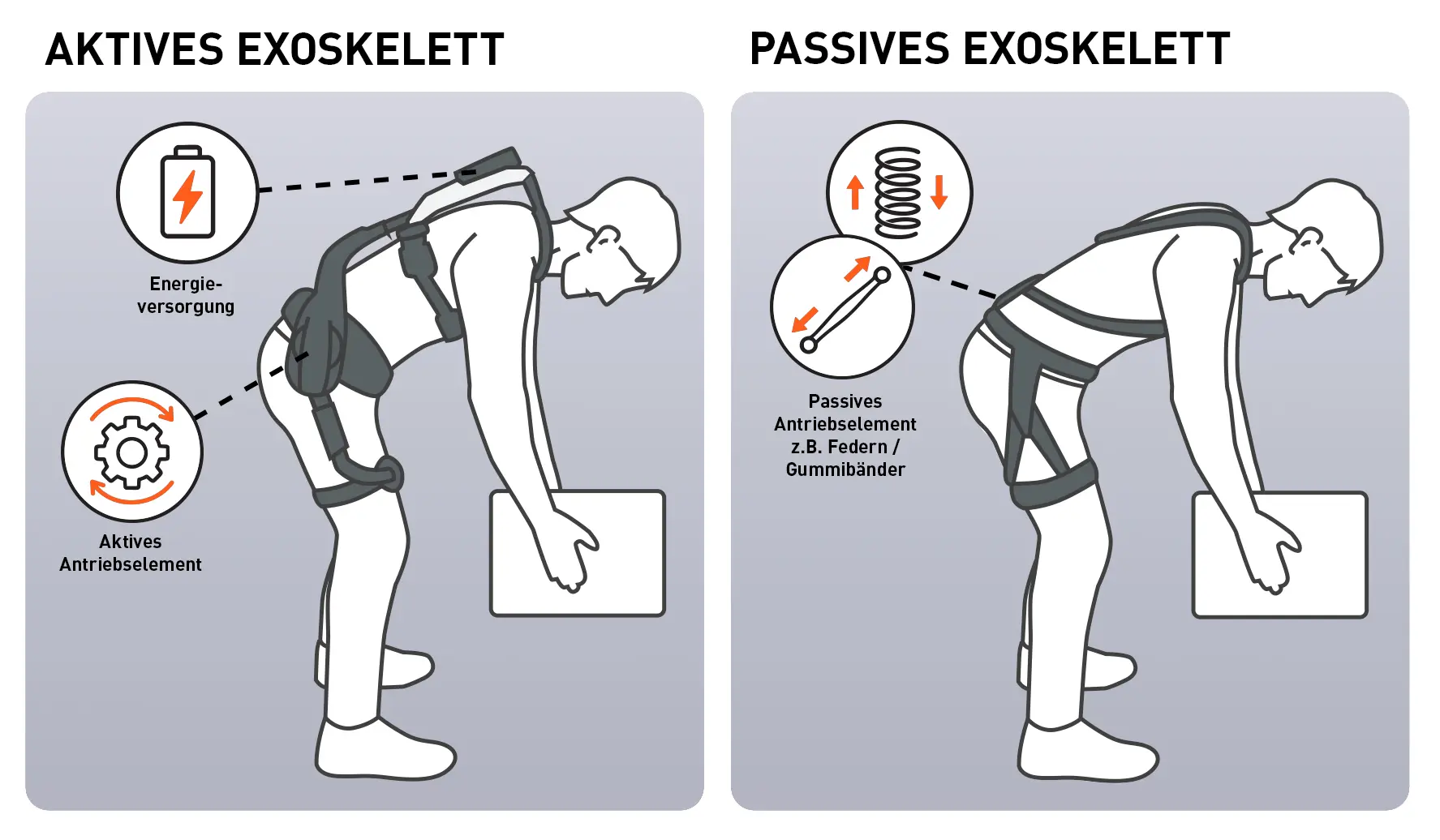
Passive exoskeletons use, for example , spring mechanisms or elastic bands to support the body during certain movements. Users pre-tension the system through their own movement. Some of the energy stored in the process is released during the next movement. This redistributes part of the physical load and relieves certain muscle groups. However, passive exoskeletons can only store and redistributethe energy that has already been applied; they do not generate any additional force assistance.
A typical example of an application is a passive shoulder exoskeleton for overhead work in industry or manufacturing. When a person raises their arms, the exoskeleton assists the movement through the spring built into it. As the arms are lowered, the spring is re-tensioned by the user’s force, preparing it to provide support the next time the arms are raised.
The Benefits of Passive Exoskeletons
- No external power source required
- low weight
- simple and sturdy design
The Disadvantages of Passive Exoskeletons
Since passive exoskeletons do not have their own power source, users must power the system using their own energy. For repetitive tasks, this recurring exertion requires additional muscle effort. As a result, the actual load-reduction effect may be less than expected.
Furthermore, passive exoskeletons can only provide support during specific movements and under specific loads. When tasks change frequently, their capabilities are limited. In addition, they typically offer less support than active exoskeletons. When handling heavy loads or performing particularly strenuous tasks, the relief they provide is therefore sometimes insufficient.
How helpful a passive exoskeleton is perceived to be also depends on the individual. Factors such as physical strength, work style, and personal perception of physical strain play a role here.
Another drawback is that the support is fixed. The system cannot automatically adapt to different loads or work situations.
When are passive exoskeletons particularly useful?
Passive systems are particularly well-suited when tools, components, or arms need to be held in a specific position for an extended period of time. In such situations, the exoskeleton can be adjusted to continuously compensate for part of the weight. Because fewer preparatory and follow-through movements are required, this results in noticeable and lasting relief.
Active Systems
How do active exoskeletons work?
Active exoskeletons have an external power source and can therefore provide targeted additional support. Depending on the system, this support is provided by electric motors, pneumatic actuators, or other drive technologies, for example.
They also feature an intelligent control system: Sensors detect users’ movements and their need for assistance. Based on this information, the system specifically adjusts the power assistance during the activity. This allows active exoskeletons to provide support even when requirements change.
The Benefits of Active Exoskeletons
- additional force assistance independent of muscle pre-tension
- Significant relief during strenuous or frequently recurring activities
- Support can be adjusted to accommodate different loads
- Suitable for dynamic and complex work processes
- Support Tailored to Individual Needs Through Sensors and Control Systems
The Disadvantages of Active Exoskeletons
This additional technology also presents challenges. Since active exoskeletons use motors, they require an external power source, usually a rechargeable battery. Therefore, factors such as battery life, charging times, and conditions at the site of use must be taken into account. In addition, due to their drive systems and control technology, active exoskeletons are generally more complex and often heavier than passive systems.
When are active exoskeletons particularly useful?
Active exoskeletons are particularly well-suited for workplaces with varying requirements. These include, for example, assembly work at different heights, handling varying loads, or complex maintenance and repair tasks. They offer advantages especially when dealing with heavy loads and physically demanding tasks.
table
A Direct Comparison of Passive and Active Exoskeletons
selection
How do I find the right exoskeleton?
Whether a passive or active exoskeleton is more suitable does not depend solely on the technology. Rather, the requirements of the specific workplace are the deciding factor. The following questions can help determine this:
- How heavy are the loads that need to be moved?
- What is the required level of support?
- Are the movement patterns relatively uniform or do they vary greatly?
- Do the loads need to be supported, pushed, pulled, or lifted?
- Which parts of the body are under particular strain?
- Is it necessary to adjust the support flexibly?
- What role do weight and range of motion play?
- What do users prefer?
A careful workplace analysis . BG BAU also recommends testing exoskeletons under real-world working conditions before purchasing them. A practical test provides valuable insights and is even eligible for a grant of up to €1,500.
In a nutshell
Passive exoskeletons can provide effective relief during clearly defined and repetitive tasks.
Active exoskeletons, in addition, offer flexible force assistance for varying loads, complex movement sequences, and high physical demands.
Which solution is the better choice depends on the specific working conditions and ergonomic goals.