How we test our active exoskeletons on our state-of-the-art test benches
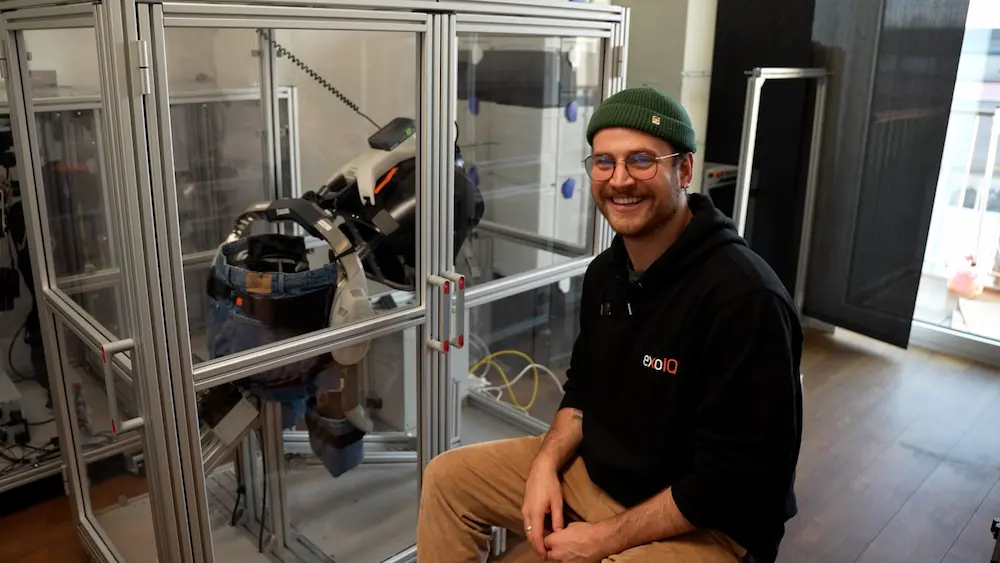
Active exoskeletons, such as our S700 active shoulder exoskeleton and the new B900 active back exoskeleton, are designed to reliably reduce the physical strain on people during their daily work—whether they’re working overhead, lifting heavy loads, or performing repetitive movements. However, before they can be put to practical use, our exoskeletons must overcome a key hurdle in addition to extensive user testing: intensive, real-world bench tests.
Why Test Benches Are Indispensable
When developing our exoskeletons, our primary focus is on providing long-term relief for employees. We make a conscious effort to invest in rigorous testing procedures—which go beyond standard tests—as a central component of our development and quality strategy. These testing procedures enable continuous improvement and ensure that our exoskeletons deliver results where it really matters: in everyday work.
To ensure that our systems remain reliable over the long term, we simulate extreme stress scenarios over extended periods on our in-house test benches. This ensures that our exoskeletons continue to provide perfect support even after years of daily use for several hours at a time.
The S700 Active Shoulder Exoskeleton in Continuous Use: Test Benches for Shoulder and Overhead Work
The test benches for the S700 active shoulder exoskeleton are designed to replicate real-world movements from assembly, logistics, or production. On full-machine test benches, the exoskeleton runs through thousands of pre-programmed cycles—over and over again, for days and weeks on end. This allows us to simulate, in a condensed timeframe, how the exoskeleton will perform over many years of intensive use. In this way, we can identify early on where optimizations are needed.
Test benches for the new B900 active back exoskeleton: Gearbox testing & heavy-duty endurance testing
To ensure the durability of the new B900 back exoskeleton, we have also developed two specialized test benches: the gearbox endurance test and the heavy-duty endurance test.
The transmission endurance test focuses on the drive unit, which in the B900 provides the active forces for the lower back. On the test bench, we evaluate, among other things, the service life of the entire drive system, the load-bearing capacity of individual mechanical components, noise levels, and heat generation.
In the second test bench profile, the B900 undergoes a particularly demanding test: the heavy-duty endurance test, which simulates continuous, intense use of the exoskeleton over several years. Real-world movement sequences are repeated thousands of times, including lifting a box, carrying and walking, setting it down and picking it up again, as well as dynamic hip and leg movements.
After testing, all anomalies are analyzed in detail—from the slightest changes in sound to material behavior under load. The results are directly incorporated into the development of our B900. This is how we create systems that ease the burden on people today and provide reliable support tomorrow.
Table of contents
Further resources
More about exoIQ

News
Find out more about the latest updates from exoIQ.
Press
Here you can get press material about us...

FAQ
Visit our FAQ page, where we collect all the information you need.

Contact
Do you have any questions about our exoskeletons? Please contact us!