Modern measurement technology meets ergonomic support: CTC relies on the S700 active shoulder exoskeleton

At Composite Technology Center / CTC GmbH (An Airbus Company) in Stade, everything revolves around research and development in the field of fiber-reinforced composites—particularly for the aerospace industry. Here, complex components made of fiber-reinforced composites are developed, manufactured, and analyzed and inspected using high-precision measurement technology.
The challenge: A wide variety of product variants and demanding quality requirements call for flexible processes and innovative manufacturing concepts.
An important step in the quality control process is the measurement of components. This involves the use of modern 3D laser scanners, which employees use to capture the component geometry manually, non-contact, and with high precision. Depending on the requirements, measurements are taken with accuracies of up to 50 micrometers (0.05 mm), resulting in datasets containing several hundred million measurement points.
For employees, this means: constantly working with their arms raised, high levels of concentration, and sustained strain on muscles and joints, with little opportunity to relieve that strain. This is exactly where our S700 active shoulder exoskeleton comes in.
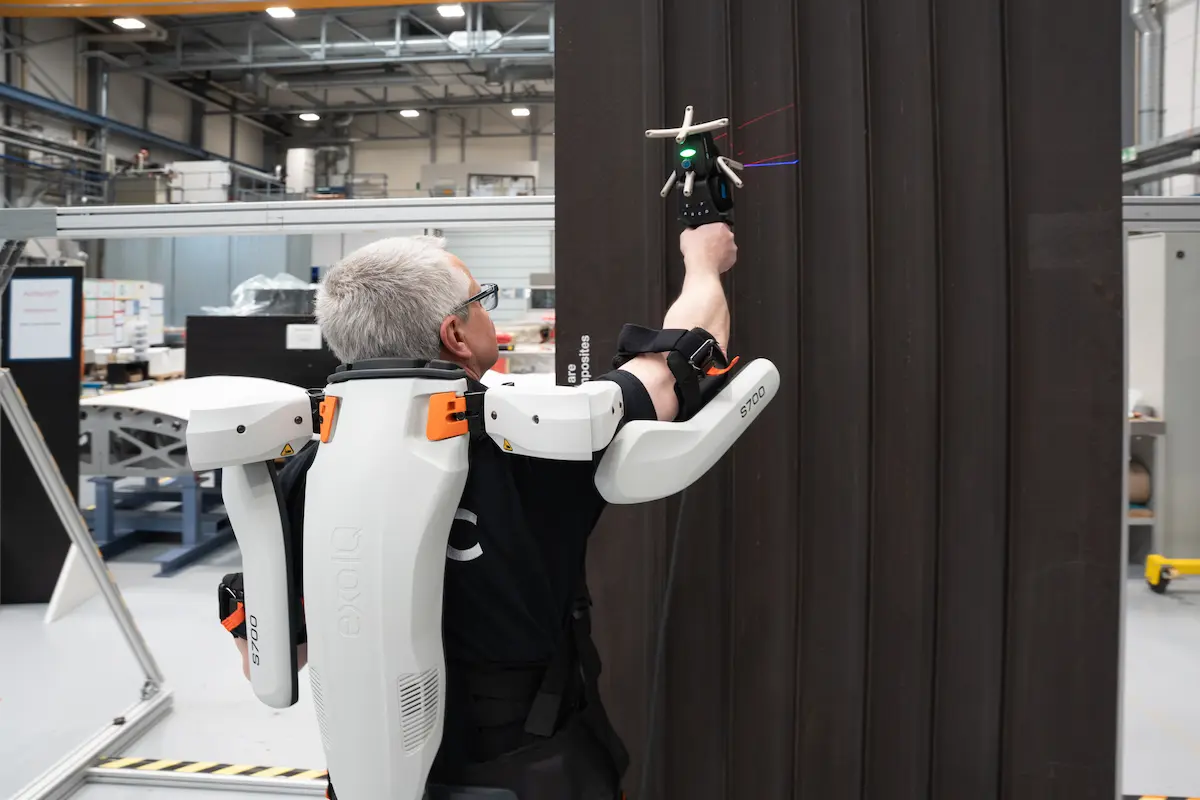
The S700 Provides Noticeable Relief in Everyday Work
With the introduction of the S700, CTC was able to significantly improve ergonomic working conditions in metrology. The active shoulder exoskeleton provides targeted support for overhead and holding tasks —precisely where the physical strain is greatest during the scanning process.
Krzysztof Lenartowicz, a metrology technician with over 15 years of experience, describes the effect this way: “The exoskeleton allows me to work in one position for longer without my arms getting heavy. I need significantly fewer breaks and experience less tension in my shoulders and neck.”
It is also widely accepted in everyday work. Users at CTC particularly highlight how intuitive it is to use: “I was surprised at how comfortable it is to wear. I had expected it to restrict my mobility—but the opposite is true,” says Krzysztof Lenartowicz.
Another advantage is how easily it integrates into existing workflows: The S700 can be put on and customized in just a few seconds.
Since several employees work in measurement technology, two systems at CTC are used by a total of four people. Replaceable and washable fabric components allow for hygienic and flexible use in a multi-user environment.
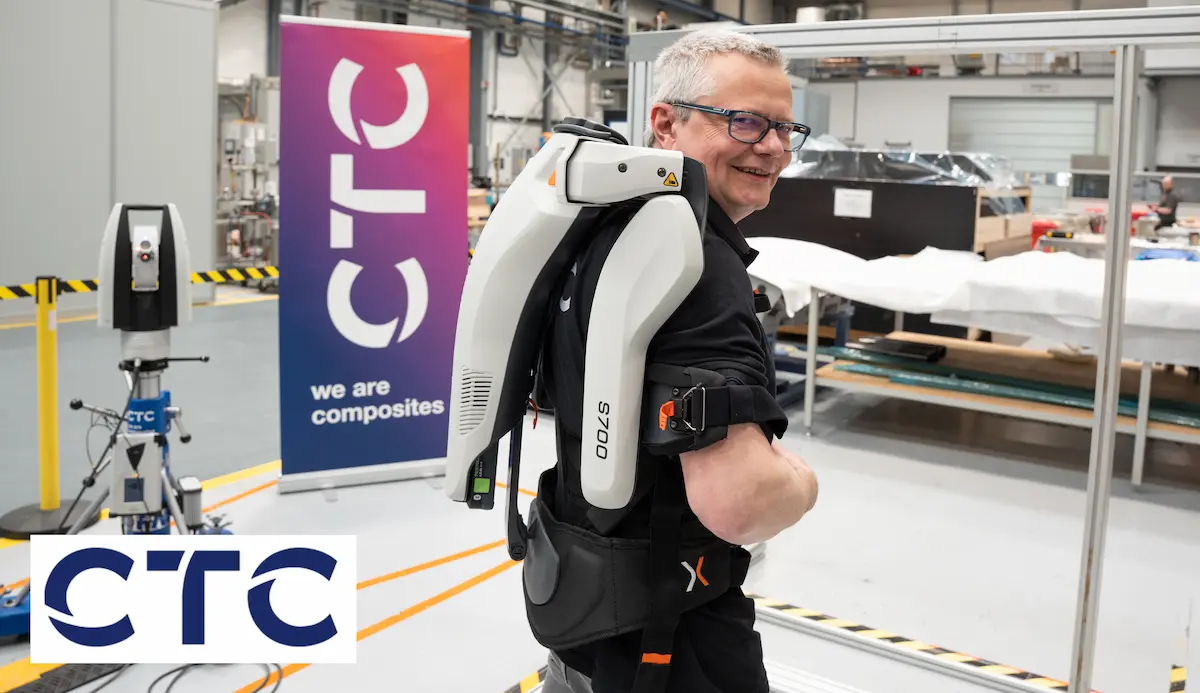
Scientifically proven: Significant reduction in muscle strain
To evaluate the ergonomic effects of the S700 not only subjectively but also objectively, an EMG-based analysis (electromyography) was conducted at CTC. During the analysis, muscle activity in the shoulder during the scanning process was systematically recorded and compared both with and without the exoskeleton.
An assessment of the workstation without an exoskeleton, based on the Borg subjective exertion scale, yielded a score of 15 (“strenuous”). This is due in particular to the prolonged elevated arm position and unfavorable joint angles in the shoulder area during the scanning process.
The use of the S700 has led to significant improvements: The required average muscle activity was reduced by 32% in the anterior shoulder muscles and by 39% in the lateral shoulder muscles. At the same time, the subjective perception of exertion also decreased significantly to a Borg score of 9 (“very easy”).
The results of the EMG analysis thus clearly demonstrate that the active shoulder exoskeleton makes a significant contribution to reducing physical strain and improves the conditions for long-term healthy and precise work in industrial metrology at CTC.

Conclusion: Increase Efficiency, Protect Health
The integration of the S700 at CTC impressively demonstrates how modern assistance systems can bring about lasting improvements in working conditions in technologically demanding fields. This provides clearly measurable added value, particularly during prolonged, static holding tasks—such as those typical in industrial metrology.
Krzysztof's conclusion sums it up perfectly: “I'm glad we have the exoskeleton. Especially when it comes to large components, I would recommend it any day.”
This positive feedback from our customer confirms once again that exoskeletons like the S700 play a crucial role in reducing physical strain across numerous industries. At the same time, they lay the foundation for greater endurance, consistently high precision, and increased satisfaction in day-to-day work.
Table of contents
Further resources
More about exoIQ

News
Find out more about the latest updates from exoIQ.
Press
Here you can get press material about us...

FAQ
Visit our FAQ page, where we collect all the information you need.

Contact
Do you have any questions about our exoskeletons? Please contact us!