Load handling in production and logistics
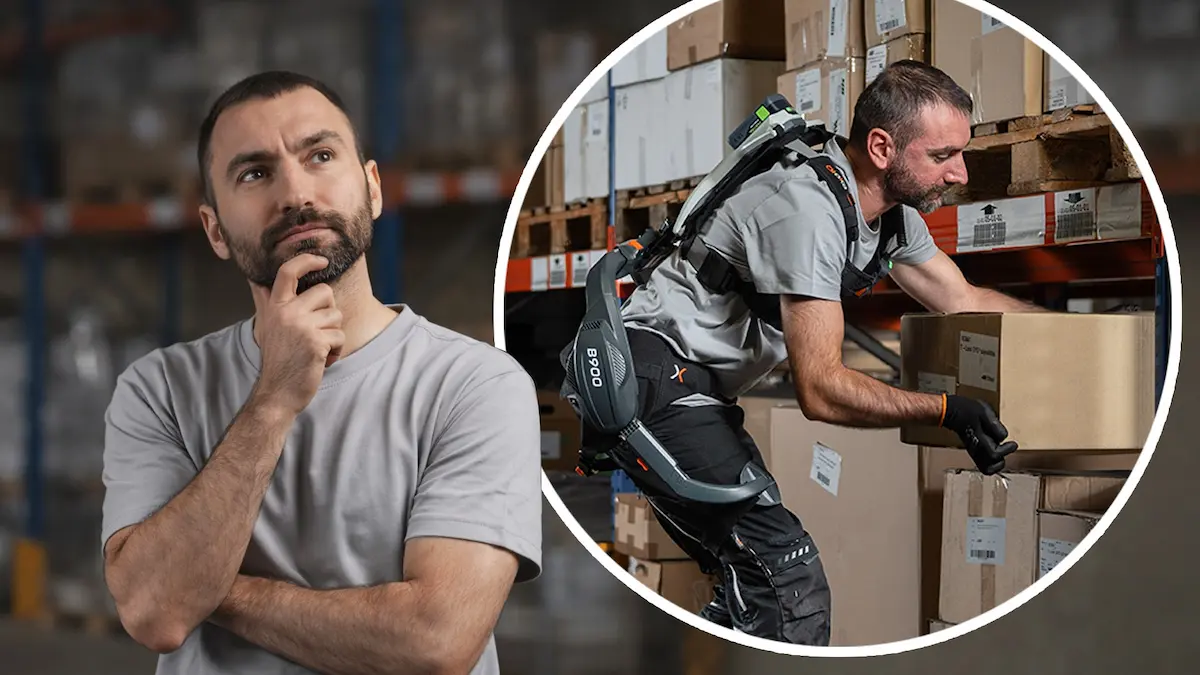
Load handling is one of the greater challenges for people and processes in many industries. Physically demanding activities such as lifting and carrying tools or pushing and pulling loaded trolleys are part of it, as are complex assembly activities at and above shoulder height. These demand a lot from the body. Loads or tool weights are usually difficult to reduce, which is why effective support systems need to be provided. This relieves the physical strain on employees and at the same time improves work processes, as symptoms of fatigue occur much later - a win-win situation for employers and employees. In the context of many physically demanding activities, the use of exoskeletons is a suitable solution to this problem.
Content:
- Common load handling challenges
- Exoskeleton as a possible solution
- Concrete examples of use of exoskeletons for load handling
- Arms, shoulders, neck
- Special stress on the back
Common load handling challenges
In production facilities, warehousing and logistics, goods, materials and much more have to be moved. These often heavy and unwieldy goods present employees with great physical challenges. This is especially true for continuous loads. The external conditions result in the work being perceived as unattractive. The most common forms of load handling are:
- Lifting and carrying - e.g. tools and raw materials
- Carrying - everything from building materials to parcels
- Pushing and pulling - roller containers, pallet trucks and other transport containers
In addition, there are numerous jobs in forced postures. This means that unergonomic postures or movements have to be adopted. In these, the musculoskeletal apparatus is stressed for a short or long period of time, or complex actions have to be performed, such as holding heavy tools overhead.
Exoskeleton as a possible solution
For load handling in flat factory halls, warehouse complexes and the like, there are a variety of aids and automation solutions that make life easier for employees. However, this is not always economical and, depending on the work area, not always practical. This is due, for example, to the immobile placement of aids such as cranes and lifts. Such static solutions unfortunately do not always do justice to the complexity of many work processes. The flexibility of human labour is and remains indispensable in many areas. To solve this problem, people themselves can be equipped with ergonomic aids.
Reducing loads adds value on many levels at once. Less fatigue through ergonomic support in load handling can not only promote quality of work and productivity. In addition, the attractiveness of the workplace increases and an increasing shortage of young talent is countered.
One possibility is the exoskeleton. Depending on the design, this offers a reinforcement of one's own muscle strength (active) or a force balance from weaker muscle parts to stronger body parts (passive). In this way, the flexibility of individual human work is preserved, but the stresses on the human body are balanced out.
Concrete examples of use of exoskeletons for load handling
Parts of the musculoskeletal system can be specifically supported using an exoskeleton. A distinction is made between active and passive variants. Active exoskeletons, for example, have electric drives that provide additional power to the movement process and offer individual support for different activities. Passive exoskeletons are usually operated mechanically, for example via spring systems. Regardless of the design, in both cases not only is the movement itself facilitated, but incorrect postures can also be prevented. Especially in repetitive production processes, they reduce the strain on employees.
Arms, shoulders, neck
The main focus here is on work that has to be done overhead or at shoulder height. This applies to lifting objects into racks as well as to overhead assembly, e.g. on the underbody of motor vehicles in the automotive sector. In such work, the main difficulty lies in holding tools and materials up for long periods of time. The exoskeleton supports the extremities and employees can concentrate fully on their work without tiring quickly.
Special stress on the back
The back is stressed during almost all load handling. This is especially true for the hip area. For any work where loads have to be lifted frequently, it is worth supporting this area of the body with an exoskeleton.
Summary
Logistics, production and handicrafts need flexible and individual solutions for numerous jobs to improve the feasibility of many heavy activities related to load handling. Exoskeletons can help with this. This applies to supporting the back, shoulders and neck when lifting, pulling and pushing goods or also when moving transport equipment such as pallet trucks or roller containers. In addition, there is the long-term lifting of tools, e.g. in production lines with overhead work. With an exoskeleton, stresses are reduced. For employees, this makes the workplace more attractive, less tiring and more pleasant, which also has a positive effect on the overall process through higher work quality.
Table of contents
Additional Resources
More about exoIQ

News
Find out more about the latest updates from exoIQ.
Press
Here you can get press material about us...

FAQ
Visit our FAQ page, where we collect all the information you need.

Contact
Do you have any questions about our exoskeletons? Please contact us!