Facilitate work in forced postures
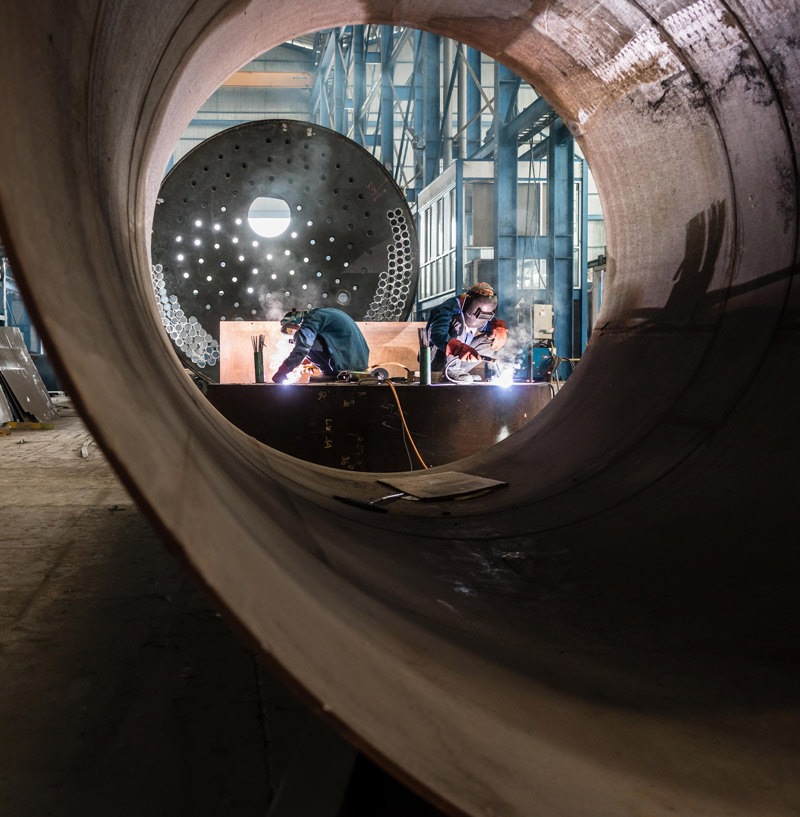
Standing, kneeling, squatting or working at and above shoulder level: activities that have to be performed in unergonomic body positions are a particular burden on employees.
Content:
- How does a forced posture develop?
- Frequent forced postures during physically demanding work
- Work in constrained postures - the exoskeleton as a possible solution
How does a forced posture develop?
Forced postures occur when an activity, workplace design or work equipment requires a certain unnatural posture or allows only limited or unergonomic movement options. This often involves extreme postures and joint angle positions. However, supposedly normal postures can also become forced postures if employees have to remain in them continuously. This is referred to as static postures. In ergonomics, this expresses the fact that:
- the posture is held for a period of more than one minute or repeatedly for more than ten seconds, and
- muscle groups or individual joints are loaded unilaterally and/or
- blood circulation in arms and legs is restricted due to posture.
Particularly when performing dynamic work steps in postures with unfavorable joint angle positions, the human musculoskeletal system is subjected to strong mechanical stresses - especially in the area of the joints.
Frequent forced postures during physically demanding work
Certain forced postures occur particularly frequently in physically demanding activities. This can be observed to a greater extent in the manufacturing industry, in transport and logistics, as well as in the skilled trades and construction industry. Concrete examples are:
- Working in a torso bend - puts strain on hips, back and lumbar vertebrae
- Working while kneeling, squatting, sitting on heels - puts strain on neck, spine, and knee joints
- Working above shoulder level - is particularly stressful for the neck, shoulders and arms.
A particularly serious problem is the duration of forced postures. The muscles cannot regenerate sufficiently because the human body is not designed to rigidly maintain body positions.
Consequently, forced postures also have a negative impact on productivity in the workplace. They lead to poor posture and movement control, lack of concentration, an increased risk of errors and ultimately to reduced performance and quality.
In view of demographic developments and the age structure on the labor market, it is therefore all the more important for companies to deal intensively with this problem in order to secure the long-term employability of their workforce.
Work in constrained postures - the exoskeleton as a possible solution
Ergonomically designed aids such as exoskeletons can counteract the physical stresses associated with forced postures. Exoskeletons provide targeted support to the musculoskeletal system and reduce overloads or distribute external loads more evenly across the body. As a result, this can mean:
- Reduction of the risk of fatigue-related injuries
- Increase in the quality of work
- Increasing operational productivity
- More attractive jobs for existing workforce and young talent
Summary
In certain workplaces, it is difficult to avoid a forced posture. Innovative exoskeletons offer a possible solution. They reduce the physical strain of demanding activities and forced postures and support strenuous movement sequences. This relieves employees, promotes productivity and satisfaction, and creates positive perspectives for the workplace.
Table of contents
Additional Resources
More about exoIQ

News
Find out more about the latest updates from exoIQ.
Press
Here you can get press material about us...

FAQ
Visit our FAQ page, where we collect all the information you need.

Contact
Do you have any questions about our exoskeletons? Please contact us!