Passive vs. active exoskeletons - modes of operation and characteristics
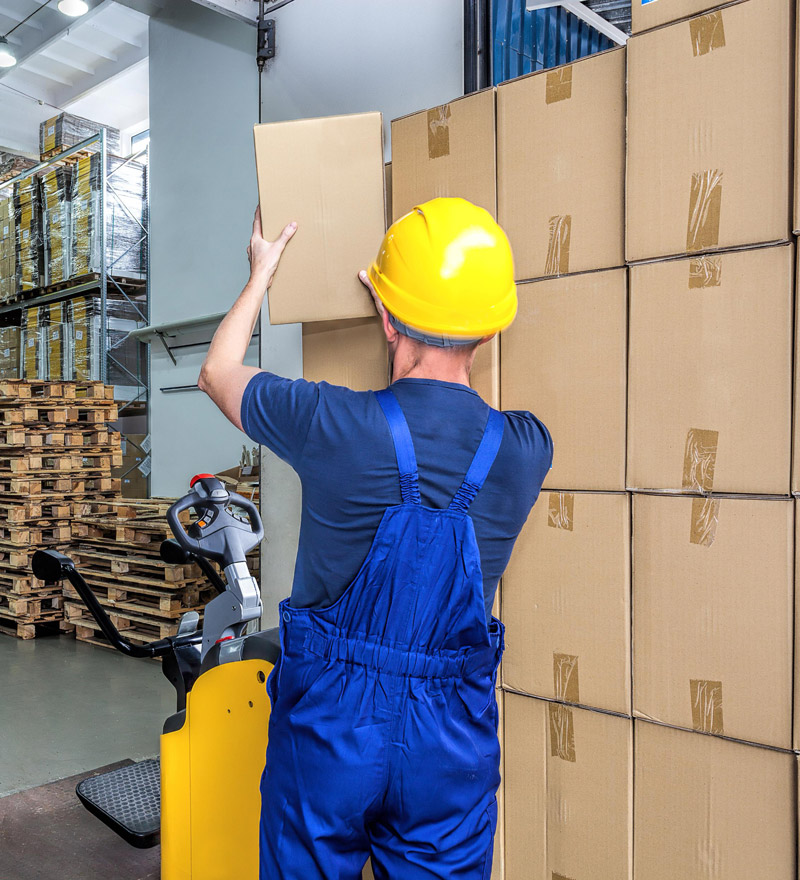
Passive and active exoskeletons essentially differ in the type of energy source. This results in suitable application possibilities in which the advantages of the respective variant can be optimally utilised. It is therefore important to make an exact analysis of the desired effect, individual circumstances of the workplace and the requirements for the respective application. In order to be able to make a well-founded assessment, a detailed comparison of the variants can be found below.
Content
- Passive exoskeletons: How they work
- Active exoskeletons: How they work
- Comparison and classification in the context of practice
- Passive exoskeletons: characteristics in practical use
- Active exoskeletons: characteristics in practical use
- Summary and overview
Passive exoskeletons: How they work
A passive exoskeleton receives its energy via the pre-tensioning of a spring mechanism or a rubber band, which must be returned to the exoskeleton via its own muscle power after each force support in the opposite direction. The tensioning force must therefore be overcome in each case. As a result, the force is redistributed and is available again for the next load movement. In this way, the load is better adapted to the natural movements of the human body. Here is an example to illustrate this:
The exoskeleton adds power during the overhead lifting process and supports the musculoskeletal system around the shoulders and arms. In the downward movement, the actuator system is "tensioned" again by the user for the next lifting process.
The available support power of the passive exoskeleton is thus limited by the force to be applied by the user to pre-tension the system. For higher support performance, e.g. when moving heavy loads, higher preloads would also have to be generated. This is not an optimal solution for all operations, especially when repetitive movements require frequent pre-tensioning of the systems. In this case, the frequency of the tensioning process could cause independent fatigue symptoms in the musculature, which would result in less physical relief than hoped for.
A passive system is best used when, for example, tools need to be held at a certain height for a longer period of time. The exoskeleton can be adjusted to counteract and neutralise the equivalent of the weight force of the tool to be lifted. Since this means that the clamping process does not have to be carried out as frequently, there is an effective saving in force.
Active exoskeletons: How they work
Active exoskeletons, on the other hand, rely on their own energy source. This can consist, for example, of electric batteries or compressed air tanks that supply electric motors or pneumatic cylinders (other forms of actuators are also conceivable) with energy. This is regulated by a control system and corresponding operating elements. Due to the additional components, active exoskeletons have a somewhat higher dead weight compared to the passive variant. Depending on the purpose and place of use, however, this can be significantly reduced by choosing cable- or hose-connected energy sources, for example, the regular power grid or an indoor compressed air system. This reduces the free mobility, but this does not always have to be a relevant criterion.
Comparison and classification in the context of practice
It shows: The decision for a passive or active exoskeleton is conditioned by the framework conditions of the workplace and the individually required activities.
Passive exoskeletons: characteristics in practical use
Passive systems are designed for a fixed force curve, as the spring characteristic of the exoskeleton determines the angle and force effect. The support characteristic is then determined by the combination of the kinematic structure of the linkage and lever arms.
Often the preload is variable and can be individually adjusted in terms of force level and maximum spring force using knurled nuts or tools.
This allows the support characteristics to be adjusted, but not during the work process. Depending on the structure and system design, the passive exoskeleton must be removed and partially converted for this purpose, which is time-consuming and often impractical. There is no variable design of the force release over the course of the movement, which is why such systems are particularly suitable for constant, but less so for work processes with high variance.
Active exoskeletons: characteristics in practical use
As with the passive variants, active exoskeletons also have system-specific types and directions of force development. They are conditioned by the actuators used and the kinematic structure. The control system nevertheless allows an adjustment during the work process within the system limits. Both the support power and the force in relation to the joint angle can be adjusted at any time. In addition, no extra force is needed to pre-tension the spring mechanism, elastic band or expander - users only need to generate counterpressure to leave the holding position. Intelligent systems can also recognise whether support is desired on the basis of the user's movements - and adapt the support power accordingly, whereby the necessary counterpressure can be reduced even further, for example. Compared to passive systems, active exoskeletons are heavier - but depending on the intended use, this can be negligible or compensated for by stationary energy supply.
Summary and overview
A direct comparison of active vs. passive exoskeletons shows optimal areas of application for both system solutions. An analysis of the workplace often shows very quickly which system solution is suitable for an ergonomic improvement.
Table of contents
Additional Resources
More about exoIQ

News
Find out more about the latest updates from exoIQ.
Press
Here you can get press material about us...

FAQ
Visit our FAQ page, where we collect all the information you need.

Contact
Do you have any questions about our exoskeletons? Please contact us!