know
Lifting heavy loads
Whether it's boxes in the warehouse, components in production, or tools on a construction site: in many work areas, loads have to be lifted, carried, or moved every day. The physical strain does not arise from the weight alone. The decisive factors are, above all, how frequently a movement is performed and the conditions under which it takes place.
Anyone who regularly moves loads often puts more strain on their body than it might initially seem. What starts as a stiff back at the end of a shift can lead to serious health problems over the years.
In this article, you will learn about the risks associated with lifting and carrying tasks, how strain can be reduced, and the role that exoskeletons can play in this.
Key points at a glance
- Lifting heavy loads is one of the most common physical strains in the workplace.
- Repeated lifting, working in a stooped posture, and moving loads far away from the body are particularly critical.
- Employees in logistics, production, skilled trades, and construction are frequently affected.
- Ergonomic working methods can reduce strain, but they cannot always be fully implemented in everyday work.
- Back exoskeletons can support employees during repetitive lifting and carrying tasks.
Definition
What is considered a heavy load?
The German Manual Handling of Loads Ordinance does not set a fixed weight limit. Whether a load can be lifted safely depends on the weight, the working conditions and the physical capacity of the individual themselves.
A load becomes a challenge primarily when it has to be moved frequently, lifted from an awkward position or carried over longer distances, for example.
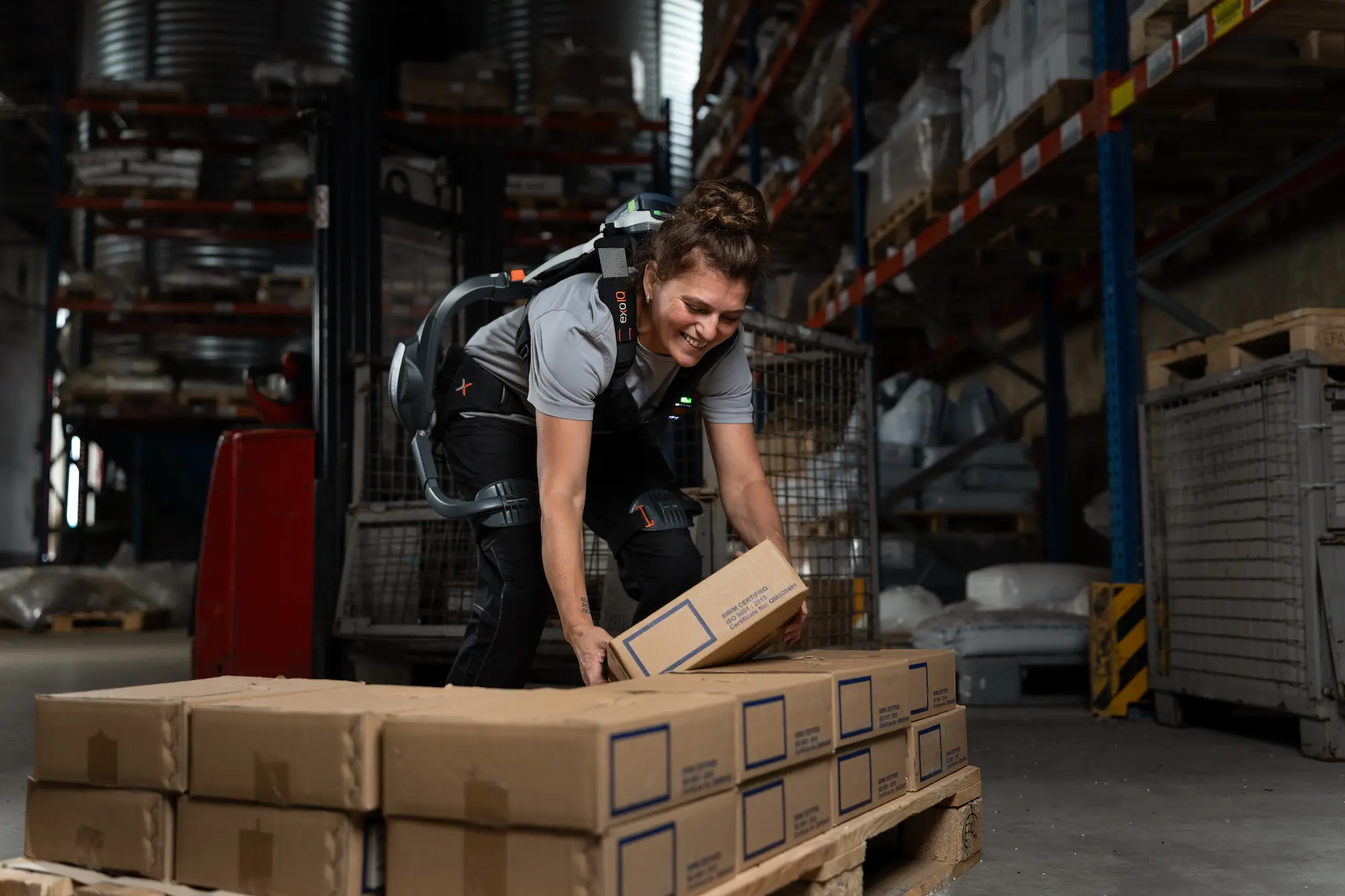
An example from logistics
An employee lifts a 15 kg box once from the floor onto a pallet. This is strenuous in the short term, but usually not an exceptional strain on the body.
The situation is different if the same employee has to pick, lift and move several hundred 5 kg cartons during a shift. Although each individual load is lighter, the strain adds up much more significantly due to the high number of repetitions.
It is not just the weight that matters
For an ergonomic assessment, it is therefore not enough to look only at the weight of a load. The decisive factor is always the interaction between weight, lifting conditions and the individual themselves.
This does not only affect warehouse jobs. Lifting and carrying are also often part of routine tasks in assembly, production and maintenance.
Further information on the ergonomic assessment of lifting and carrying tasks is defined in the Key Indicator Method of the Federal Institute for Occupational Safety and Health (BAuA).
Background
Why does repetitive or heavy lifting put a strain on the back?
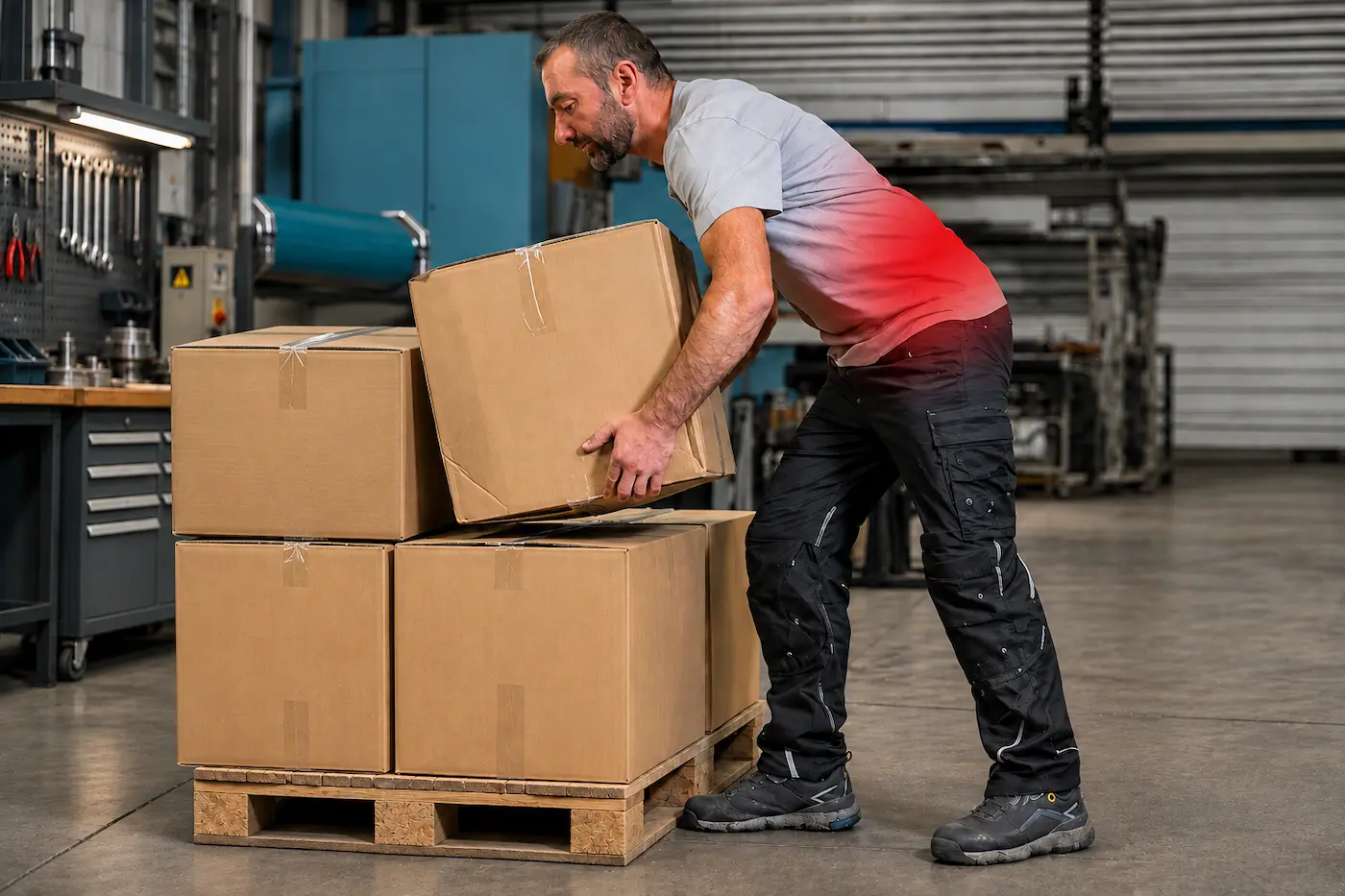
When a load is lifted in front of the body, the back muscles must do more than just support the load itself. They must also prevent the upper body from tipping forward. This means they have to support not only the load, but also the weight of the upper body, while additionally stabilising the trunk.
The strain is particularly high in situations where the load:
- is held far away from the body
- is picked up from a bent-over position
- is moved with a twisted torso
- has to be lifted repeatedly
The greater the distance between the load and the body, the harder the back muscles have to work. Even a few extra centimetres away from the body's centre can make a significant difference. For this reason, loads should be handled as close to the body as possible.
Causes
How does pain develop?
Over the course of a working day, muscles become increasingly fatigued. As a result, movements often become less precise when exhausted, and ergonomic poor posture increases. Consequently, individual parts of the body are subjected to additional strain.
The most common causes of discomfort:
- muscular overexertion
- tension
- insufficient recovery times
- persistently awkward postures
- frequent repetition of the same movement sequences
The combination of heavy loads, frequent repetitions and awkward postures in particular can lead to physical overexertion.
Consequences
Long-term consequences of repeated lifting and carrying tasks
Not every physical overexertion is immediately noticeable. Many negative after-effects develop gradually over months or years. Activities that require employees to regularly lift, carry, bend down or move loads are particularly problematic. Without sufficient relief and recovery, recurring strain can lead to long-term health issues.
This has consequences not only for employees but also for the company. Physical complaints can primarily lead to productivity losses and absenteeism. Musculoskeletal disorders in particular have been among the most common causes of incapacity for work for years.* This makes it all the more important to identify risks at an early stage and optimise working conditions ergonomically.
* Source: Absenteeism Report 2024 Badura/Ducki/Baumgardt/Meyer/Schröder (Eds.) Focus: Commitment and Health – Attracting and Retaining Skilled Workers. Springer-Verlag Berlin 2024
Potential consequences:
- recurrent back pain
- tension in the shoulder and neck area
- strain on muscles and tendons
- restricted mobility
- faster physical fatigue
- Musculoskeletal disorders
Practical tips
Lifting heavy loads correctly
Assess the load
Before lifting, check whether the weight, size and shape of the load allow for safe handling. If the load is too heavy or unwieldy, you should use suitable aids.
Adopt a secure stance
A stable stance improves control over the movement. Before lifting, clear any potential trip hazards or obstacles in the work area.
Keep the load close to your body
The closer a load is held to the body, the lower the strain on the back and spine.
Lift in a controlled manner
Lift the load as evenly as possible and without jerky movements. Sudden peak loads can place additional strain on muscles and joints.
Avoid twisting movements
If a load needs to be moved, the movement should be carried out using your feet and your whole body wherever possible. Twisting your upper body while lifting increases the strain even further.
Prevention
How to reduce physical strain
Lifting heavy loads is part of everyday life in many work environments and cannot always be avoided. It is therefore all the more important to keep physical strain to a minimum. With the right tools, work processes and behaviours, peak loads can be significantly reduced and physical complaints prevented. A combination of different measures is particularly effective.
Technical measures, e.g.
- Lift tables
- Lifting aids
- Cranes
- Manipulators
- Conveyor technology
Organisational measures, e.g.
- Job rotation
- Team lifting for heavy loads
- adapted work processes
- sufficient recovery periods
- ergonomic workplace design
Individual-related measures, e.g.
- Instruction on correct lifting and carrying techniques
- Ergonomics training
- Raising awareness of physical strain
- Support systems for strenuous tasks
Relief
How exoskeletons can support the lifting of heavy loads
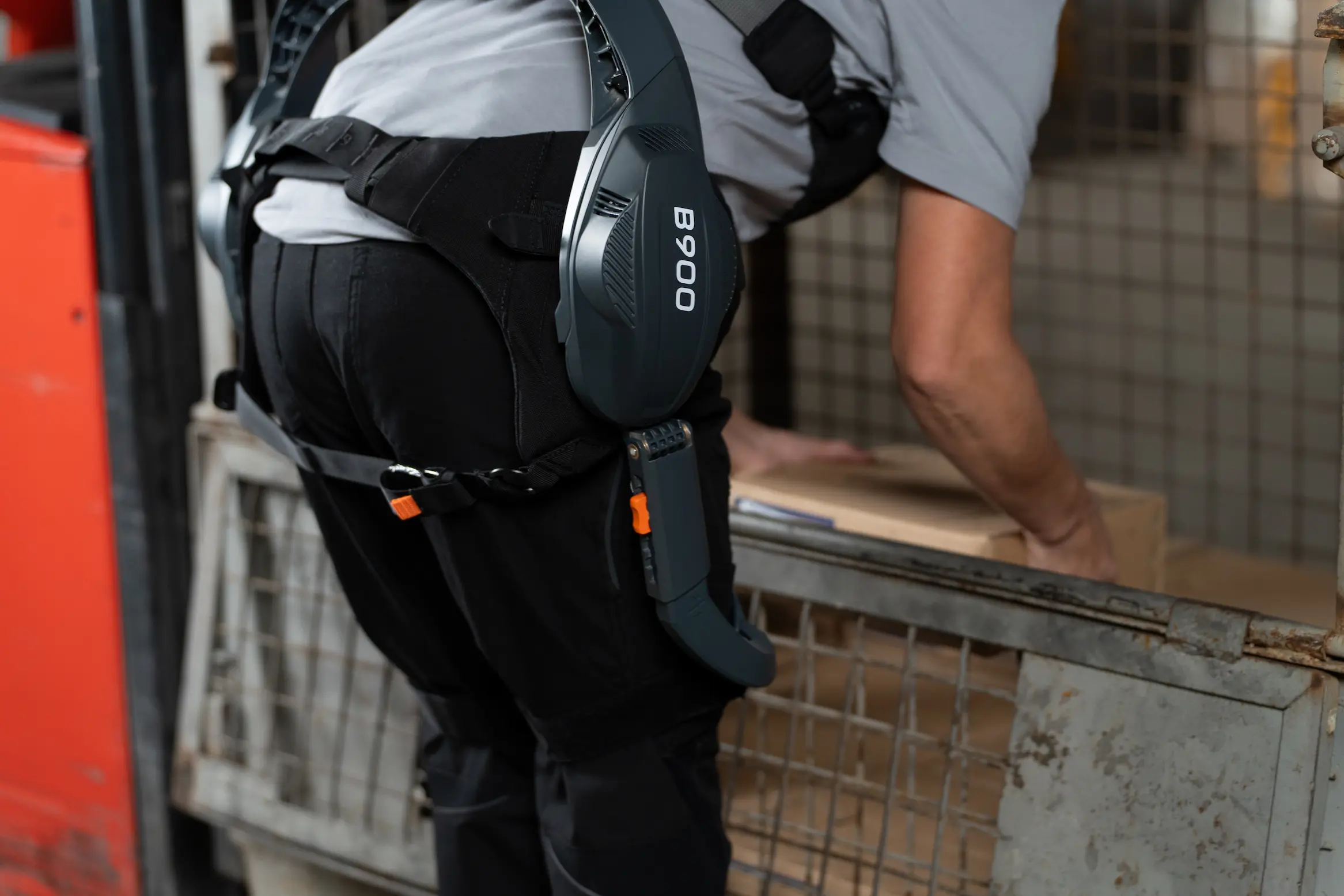
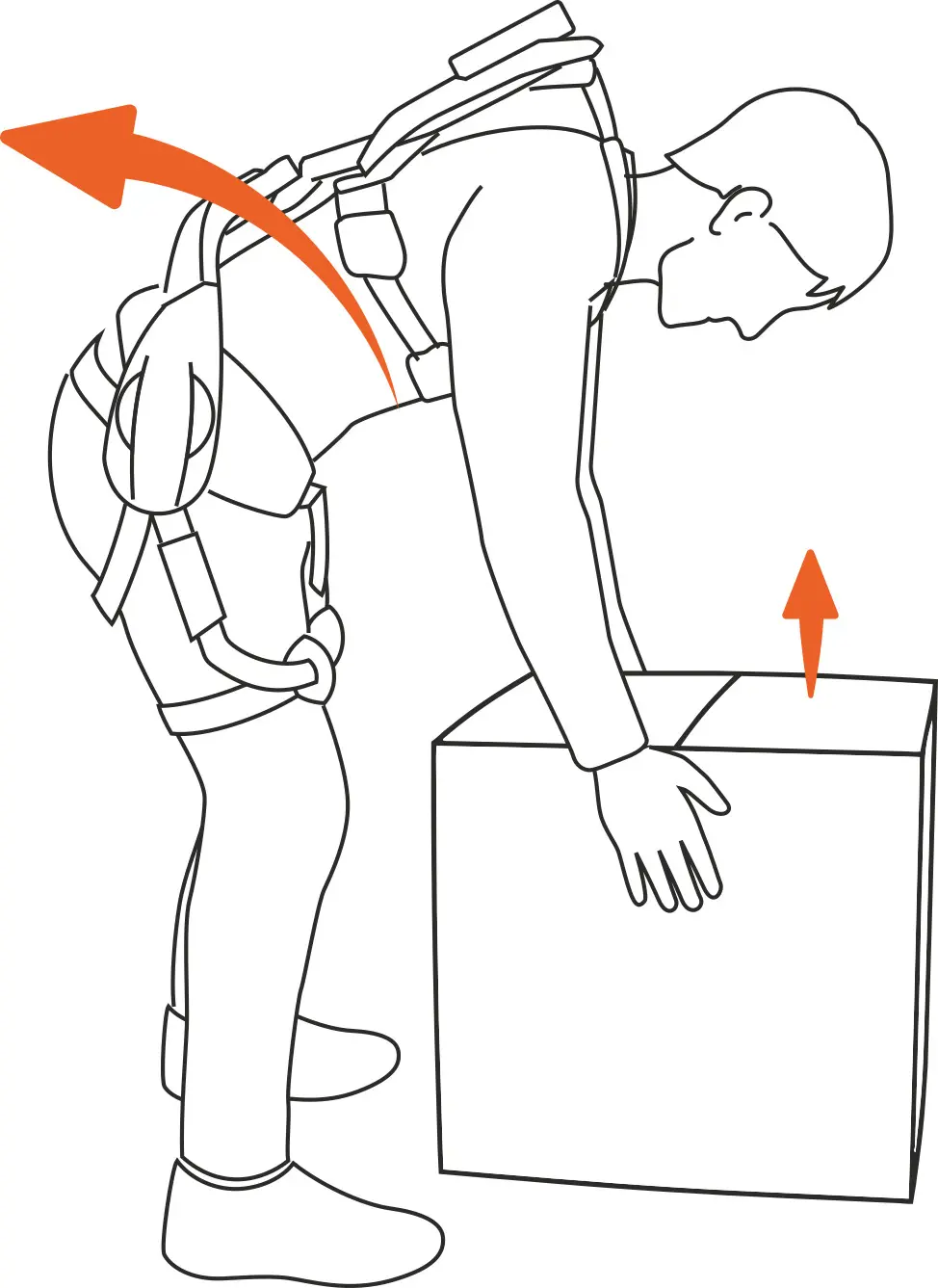
Exoskeletons are increasingly being used when employees regularly have to lift, carry or move loads. Active exoskeletons in particular, such as the B900 back exoskeleton, can provide effective support in this regard.
Unlike passive exoskeletons, which merely store and release energy, the B900 features a powerful electric drive. This detects the wearer's lifting and straightening movements and provides targeted support with additional power. This actively relieves the back and muscles, especially during strenuous phases of movement.
Typical areas of application for exoskeletons
Exoskeletons are particularly advantageous for activities that require frequent lifting and carrying, e.g.
- Order picking in the warehouse
- Material handling in production and logistics
- Loading and unloading processes
- Assembly and maintenance work
- repeated bending, lifting, and repositioning of components
Because the exoskeleton is worn directly on the body, the support can be used regardless of the specific workstation. This allows employees to benefit from active relief when lifting and carrying heavy loads, even when tasks change.